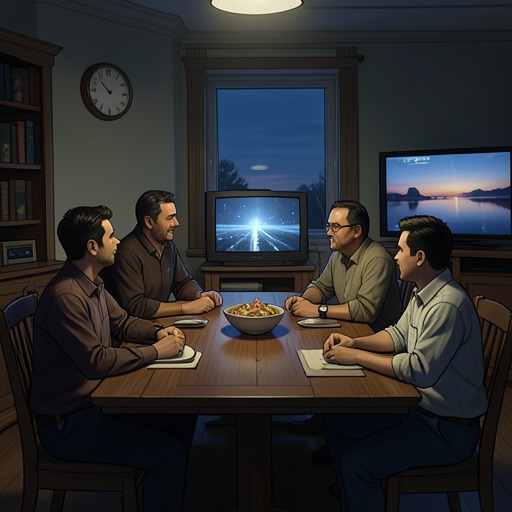
Aristotle’s moments
The Museum of InnocenceAristotle’s moments is Kemal’s way of understanding how particular instants survive inside the continuous passage of time. A glance, a television image, or an object touched during an evening can retain the feeling of a whole experience; by gathering and revisiting such fragments, he tries to preserve the happiness he shared with Füsun and her family against the knowledge that time ends.
The Moment and the Line of Time
Kemal recalls Aristotle’s distinction in Physics between time, the line connecting one present to the next, and individual present moments, which he describes as indivisible. The metaphor becomes personal through Kemal’s years of suppers at the Keskin family home in Çukurcuma. He knows that the moments there will pass and that the line connecting them leads toward loss, yet Füsun’s smile can give a single present enough happiness to sustain him. His visits are, in this sense, an attempt to gather a store of joy for the rest of his life.
The distinction also clarifies why remembering is not simply comforting. Once Kemal can look back and identify a moment as the happiest of his life, he must recognize that it belongs to the past and will not return. Retelling the story gives that instant a place in a comprehensible sequence, but it also makes the distance from it unmistakable. The earring that fell onto the blue sheet during the moment he later names as his happiest becomes one material trace of an instant whose vividness and irrecoverability are inseparable.
Images Preserved at the Dinner Table
The television evenings at the Keskin home show how a remembered moment can be made from details peripheral to a program’s plot. Kemal retains fragments such as a detective’s shoes and trouser cuffs on a staircase, a chimney caught at the edge of a frame, a woman tucking back her hair, a girl holding close to her father at a football match, or a ferry visible behind the action in a Turkish film. The program itself may disappear from memory; a small image remains.
Those screen fragments are joined to Füsun’s particular presence at the table: the corner of her mouth, her raised eyebrows, the position of her hand, or the way she put down her fork or stubbed out a cigarette. The remembered unit is therefore not just a scene watched but a conjunction of image, gesture, and shared domestic setting. Kemal later gives artists detailed instructions for making such memories visible in the Museum of Innocence, while acknowledging that he cannot supply an exact answer to what had moved Füsun in a given scene. The preserved image keeps the moment’s force without resolving its mystery.
Objects as Carriers of Particular Instants
Cigarette stubs become especially close to Kemal’s idea of the moment. Sometimes he takes one from an evening, sometimes several; back at the Merhamet Apartments, handling them one by one brings back separate moments from the past. Their importance lies in their particularity: each stub belongs to an occasion, rather than merely representing a general period of longing.
Other objects collected from the Keskin kitchen and home work in the same way. A porcelain saltshaker, a tape measure shaped like a dog, a can opener, and a bottle of Batanay sunflower oil each become associated with a particular evening. As the years pass, the memories connected to them seem to expand and merge. Eventually Kemal no longer needs to pick up each object: seeing it is enough to call back the shared dinners and, through them, the larger experience of sitting with Füsun and her family. The collection makes memory retrievable through things, while also revealing how no single object contains the whole past by itself.
Domestic Time Against Public Time
Kemal’s sense of being outside time during television evenings depends on a fragile quiet. The regular images on the screen and the repeated rhythm of supper allow him to remain with the Keskin family, but the news breaks that suspension by reporting the country’s descent toward civil war. By 1978, bombs and armed clashes had reached the neighborhoods around Çukurcuma, Tophane, and Cihangir. The ordinary evening is thus held between two temporal orders: the intimate recurrence of meals and television, and the public sequence of political violence that cannot be kept outside the home.
The same contrast appears in Kemal’s memories of funerals and of his father’s death. As a child, he and his brother imitated funeral bearers in the apartment corridor with heavy bolsters, turning a public ceremony into a familiar household spectacle. Later, after his father dies, drawers of bills, telegrams, medicines, and cough syrup, along with the ordinary view down Teşvikiye Avenue, acquire the value of a lost world. These objects and scenes are not interchangeable with the private moments at the Keskin table, but they show how an event changes what the surrounding everyday details mean.
Memory Made into a Museum
Kemal’s collecting and the Museum of Innocence give Aristotle’s moments a physical and narrative form. In Paris, away from Istanbul, he finds that he can see both Füsun and his own obsession from a greater distance; quiet museums offer consolation through rooms where objects stand apart from the city’s bustle. He later seeks film photographs, posters, and ticket stubs from the summer of 1976 for his own museum, encountering collectors who regard their collections as private consolations as well as sources of embarrassment.
The museum’s arrangement turns separate objects into a path through remembered experience. It cannot restore the original present or erase the line of time that leads to death. Instead, it allows visitors to encounter fragments in sequence, much as Kemal recalls a dinner through one object after another. Aristotle’s moments therefore names both a theory of memory and the method of Kemal’s collection: singular instants persist in material traces, and their arrangement makes a vanished life momentarily available again.